



Open any fitness app and you’ll be hit with hundreds of exercises. Cable kickbacks, Bulgarian split squats, landmine rotations, something with a name that sounds like a yoga pose crossed with a cocktail.
It’s overwhelming. And for most people it’s completely unnecessary.
When I strip strength training back to what actually matters, it comes down to four basic movement patterns. Get good at these, keep making them harder, and you’ll build a strong, capable body. Everything else is detail. Useful detail, sometimes, but detail.
Why patterns, not exercises
Your body doesn’t really think in terms of individual muscles. It thinks in movements. When you pick a toddler up off the floor, you don’t isolate your hamstrings. Your legs, hips, back, core and arms all work together.
That’s why I like to organise training around patterns. Each pattern has lots of variations, from beginner-friendly to seriously advanced, so you can keep training the same pattern for years while the exercise gets harder.
Here are the four.
1. The squat
Bending your knees and hips to lower yourself down, then standing back up. You do it every time you sit on a chair or get out of the car.
The squat mostly works your quads and glutes, with a big contribution from your core to keep you upright. Start with a bodyweight squat to a box or bench, so you know how deep to go. Then progress to a goblet squat, holding a dumbbell or kettlebell against your chest. Eventually you might move to a barbell.
What to focus on: feet roughly shoulder-width apart, chest up, knees tracking in line with your toes, and your whole foot staying planted.
2. The hinge
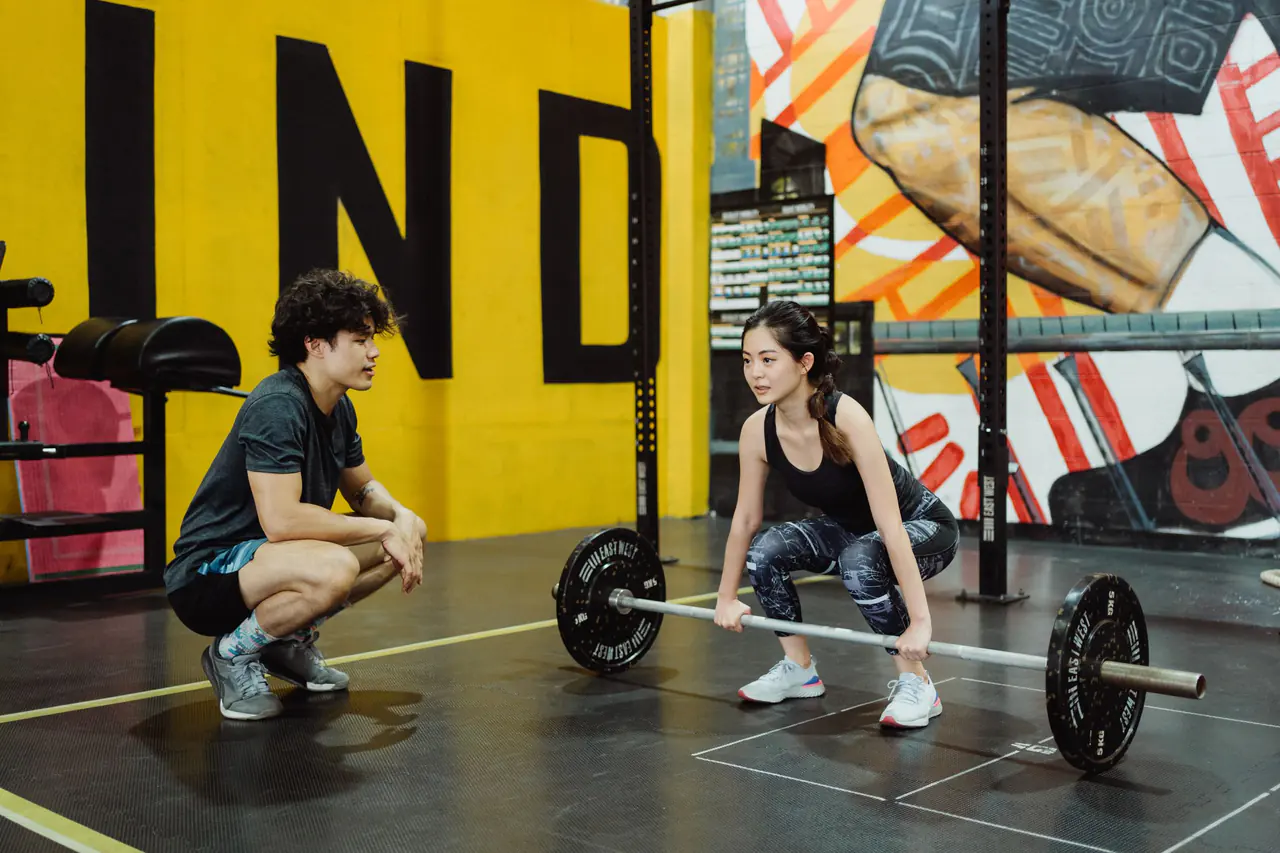
Pushing your hips back while keeping your back flat, then driving them forward to stand tall. This is how you should pick things up off the floor.
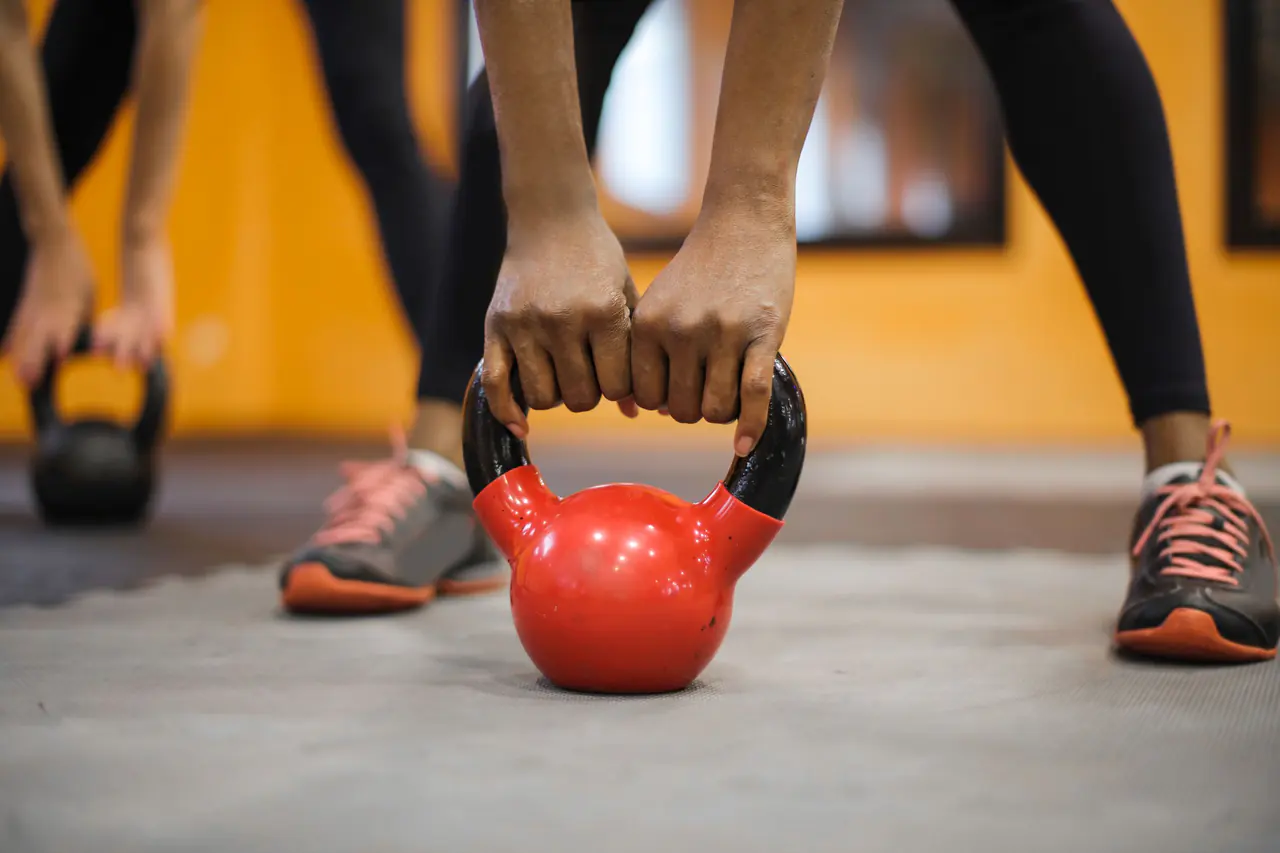
The hinge works your glutes, hamstrings and the muscles along your back. Think deadlifts, kettlebell swings and hip thrusts. A lot of people go their whole lives without learning to hinge properly, then wonder why their lower back is sore after gardening.
Start by standing a little in front of a wall and reaching your bum back to touch it, keeping a slight bend in your knees. Once that feels natural, add a kettlebell deadlift from a raised surface, then work towards lifting from the floor.
If you only learn one movement properly, make it the hinge. Your lower back will thank you for decades.
3. The push
Pushing a weight away from your body, either in front of you or overhead. Think push-ups, bench press and shoulder press.
Pushing works your chest, shoulders and triceps. It’s what you use to push yourself up off the floor, shove a heavy door open or lift a bag into an overhead locker.
Push-ups are the classic starting point, and they scale beautifully. Begin with your hands on a bench or the wall, lower the height over time, and eventually do them from the floor. For overhead pushing, a seated or standing dumbbell press is a great place to start.
4. The pull
Pulling a weight towards your body. Rows, pull-ups and lat pulldowns all fit here.
Pulling works your back and biceps, and it’s the great balancer. Most of us spend all day hunched over phones, laptops and steering wheels. Strengthening the muscles that pull your shoulders back helps you stand taller and keeps your shoulders healthy.
A good rule of thumb is to do at least as much pulling as pushing. Start with rows using a band, cable or dumbbell, then progress to inverted rows under a bar and eventually assisted pull-ups.
The bonus: carry something heavy
If there’s a fifth pattern, it’s the loaded carry. Pick up something heavy and walk with it. Farmer’s carries, with a weight in each hand, are the simplest version.
Carries train your grip, shoulders, core and legs all at once, and they’re about as practical as exercise gets. It’s literally carrying the shopping, just on purpose. They’re also hard to get wrong, which makes them great for beginners.
Putting it together
Here’s a simple full-body session built from these patterns:
- Goblet squat: 3 sets of 8–10
- Kettlebell deadlift: 3 sets of 8–10
- Push-up (at whatever height suits you): 3 sets of 8–12
- Dumbbell row: 3 sets of 10 each side
- Farmer’s carry: 3 walks of about 30 metres
Do that two or three times a week, add a little weight or a few reps when it starts to feel easy, and you’ve got a program that will make most people noticeably stronger within a couple of months.
That’s the other key ingredient: progression. Your body adapts to what you ask of it. If the workload never increases, neither does your strength.
Technique first, always
I can’t stress this enough. Learn each pattern with a light weight before you load it up. A good squat with a 10 kg kettlebell beats an ugly squat with a barbell every single time.
This is where coaching makes a huge difference. A trained eye picks up the small things, like knees caving in, a rounding back or shoulders shrugging up, that you can’t see yourself. In our Sweat Strong classes and semi-private sessions, these four patterns are the backbone of almost everything we do, and our coaches spend a lot of time making sure you’re doing them well.
Once these are solid, by all means add some extras you enjoy. Lunges, hip thrusts, curls and core work all have their place. But they’re the seasoning, not the meal.
Keep it simple. Squat, hinge, push, pull, carry. Get good at them, get strong at them, and keep turning up.
To see why these movements matter so much as we get older, read Muscle Is Your Retirement Plan.